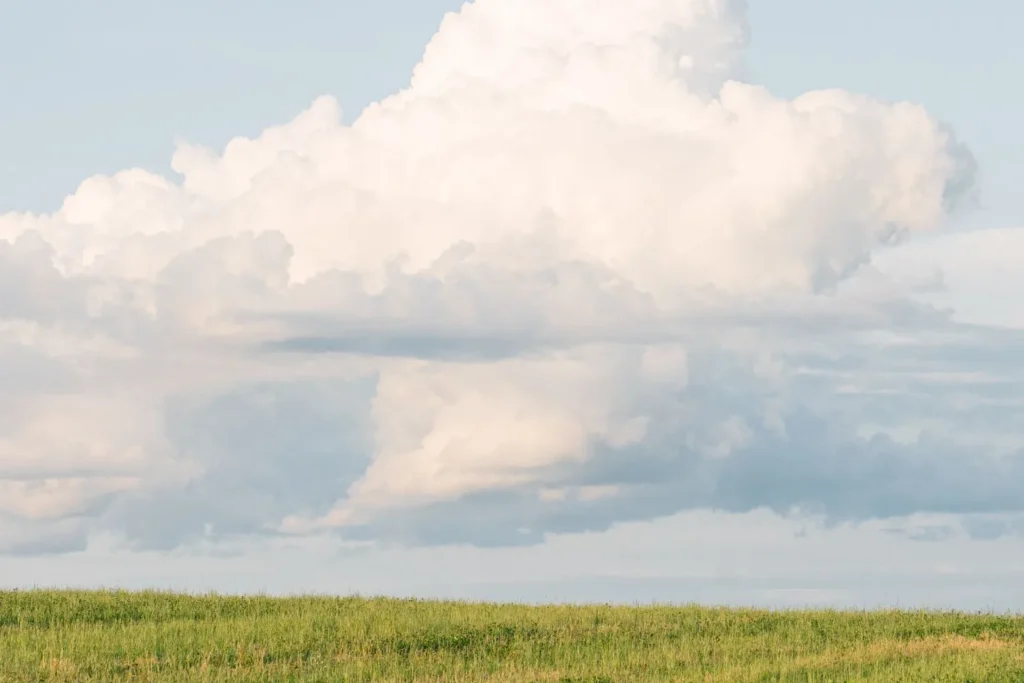
Hello, Trailhitters! This is your day, so up and away!
The days are short now. The sun gets up late and goes to bed early, and some of you spend more time looking out the schoolroom window than you would like to admit.
Good. Keep looking, but look up. There is a picture gallery over your head. It costs nothing to visit, and the pictures change every minute.
A gallery in the sky
I once opened a whole radio trip with a little verse about it:
“Clouds form patterns in the sky,
[Against] a sea of blue,
Edged with strands of silver thread
Where the sun breaks through;
Fleets of sails go billowing by
Snowmen turn and tumble,
Covered wagons roll along
On wheels that almost rumble.”From Picture Galleries in the Sky, Afield with Ranger Mac, Dec. 2, 1940
I didn’t learn to love clouds from a book. I learned it flat on my back:
“As a boy, I used to lie on my back for hours at a time and watch them gather and change form.”
From Picture Galleries in the Sky, Afield with Ranger Mac, Dec. 2, 1940
Mountains piled on mountains. Old men with beards and rumpled hair. Sailboats on a blue sea. You only need a little imagination, and you have plenty.
Where a cloud comes from
Water is a great one for disguises. In a stream it is a ribbon. On the grass it is dew. On the window it is frost. And when it floats in the air where you can’t see it at all, we call it water vapor.
There is one magic word that makes the hidden water show itself again. That word is cold.
Breathe out on a frosty morning and watch the little white puff. Your warm, damp breath hit cold air, and the vapor turned into tiny drops you can see. Congratulations: you just made a small cloud.
The sky does the same thing, only bigger. Warm air near the ground rises. As it climbs, it cools. The vapor turns into countless tiny droplets, so light they float. That is a cloud.
Four clouds every Trailhitter should know
- Cirrus means “featherlike.” These are thin, wispy clouds, the highest of all, made of tiny bits of ice. Some folks call them mare’s tails.
- Stratus means “layer.” These lie in flat bands or sheets, like a fog that got up off the ground.
- Cumulus means “piled up.” These are the big white heaps with flat bottoms. They make the best pictures.
- Nimbus clouds bring the rain and snow. They often spread gray over the whole sky.
Catch a jewel
When the snow comes, don’t just shovel it. Look at it. Let a few flakes land on your dark coat sleeve or a piece of black cloth.
“Then examine a flake with a [pocket] lens, if you have one, if not, use the naked eye. And you will see a jewel more beautiful than any ever fashioned by the hand of man. Examine as many as you will, and you will find them all different; and yet they are all alike [in] having six spokes.”
From Picture Galleries in the Sky, Afield with Ranger Mac, Dec. 2, 1940
Today we know
- There are ten main kinds of clouds. Weather scientists around the world use ten main cloud types, listed in the International Cloud Atlas. Many of the names are built from the four words above, like cumulonimbus (a thunderhead) and nimbostratus (a gray rain or snow cloud).
- Every cloud droplet needs a seed. Water vapor turns into a droplet around a tiny speck in the air, such as dust, sea salt or smoke.
- Six sides, every time. Snow crystals have six sides because of the way water molecules fit together when they freeze. Big, branching flakes are so complicated that finding two exactly alike is very unlikely, but tiny, simple crystals can look the same.
Your job this week
- On the next day with clouds, watch the sky for ten minutes. Lie on a sled in the yard, or sit by a window.
- Find two different kinds of clouds from the list. Draw each one and write its name.
- Find one picture in the clouds: an animal, a face, a ship. Give it a name of your own and draw it.
- When it snows, catch some flakes on something dark. Look closely and count the spokes.
- Put your best drawing in your nature scrapbook.
No day is dark and dreary if you remember to look up.
I’ll be seeing you on the trail.
Written in Ranger Mac’s voice by the rangermac.org team, from his radio script Picture Galleries in the Sky (Dec. 2, 1940, PDF). The quoted lines are his own words; words in [brackets] were fixed where the old scan is hard to read.
Photo: Grisha Besko on Pexels (Pexels License).
More from Ranger Mac
Afield With Ranger Mac
Don’t you believe it: nature’s tall tales
By Ranger Mac
Read more about Don’t you believe it: nature’s tall tales →
Afield With Ranger Mac
Come on, winter: find next year’s buds
By Ranger Mac
Read more about Come on, winter: find next year’s buds →
Afield With Ranger Mac
From the Archive: Winter Ways (1947)
By Ranger Mac
Read more about From the Archive: Winter Ways (1947) →Afield with Ranger Mac
Hear the original radio broadcasts
Listen to Ranger Mac on the Wisconsin School of the Air, or read his scripts and field guides.